Artificial Intelligence and the Fiction Writer’s Existential Crisis
Why AI can organize your plot, fix your grammar, and still not understand why your villain suddenly became hotter than the love interest
4 min read
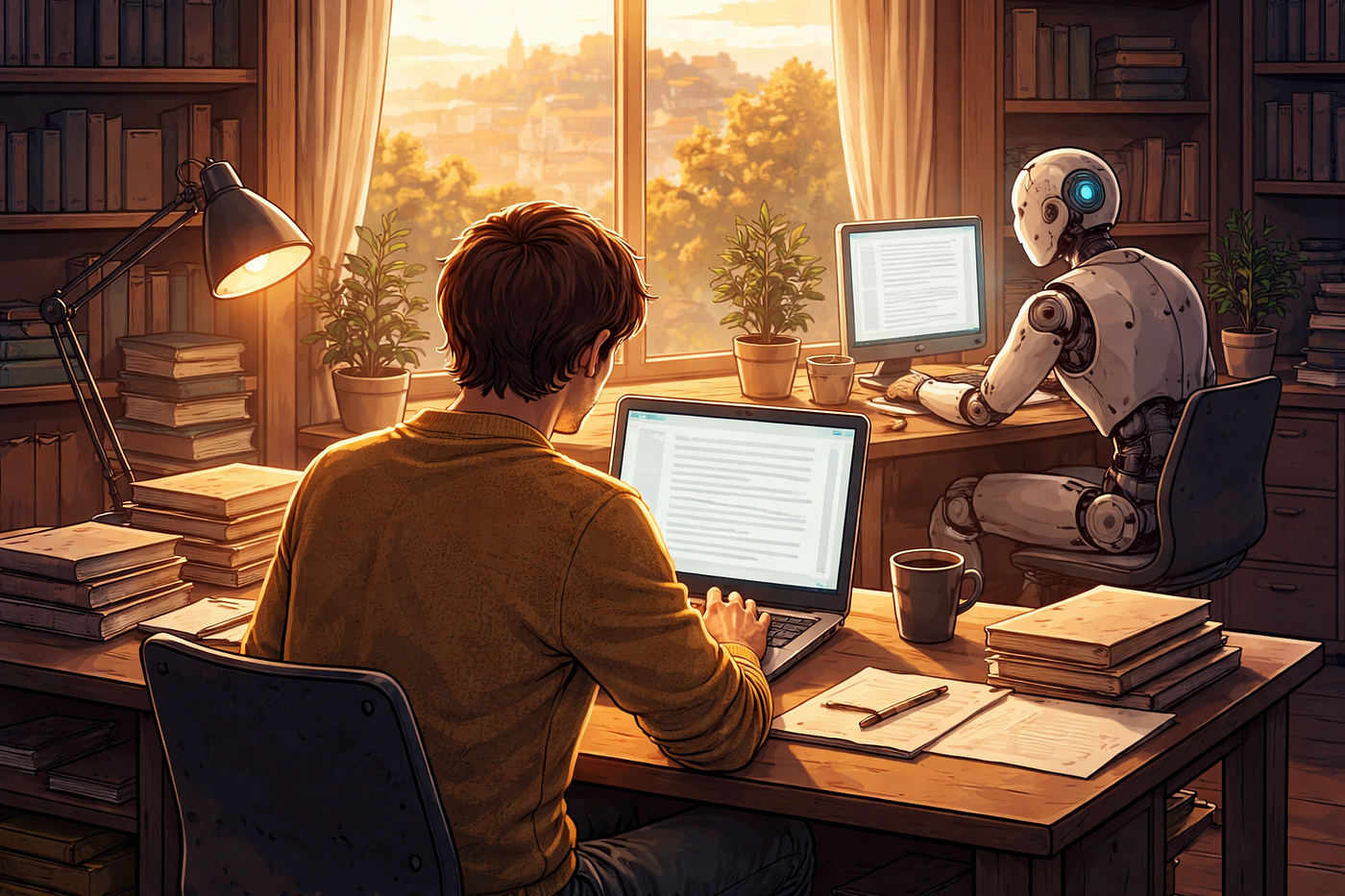
Artificial intelligence has entered the writing world like an overenthusiastic intern armed with caffeine, confidence, and absolutely no understanding of boundaries.
One-minute writers were quietly battling plot holes and emotionally unstable protagonists in peace. The next, every second social media post was either proclaiming AI would revolutionize publishing or declaring it the beginning of the creative apocalypse.
Naturally, the internet reacted with all the calm restraint of a raccoon trapped in a trash can. As someone who writes fiction, particularly darker fiction, I find the whole debate fascinating. Mostly because people seem to sit at one of two extremes. Either AI is the greatest tool ever invented, capable of helping writers brainstorm, edit, market, and organize their ideas. Or it is a soulless creativity vampire here to destroy art itself while simultaneously stealing your job and possibly your firstborn child.
The truth, as usual, is probably somewhere in the middle. Let me start by saying this. AI cannot replace human storytelling.
Can it string coherent sentences together? Sure. Can it generate a decent blurb, summarize information, or help untangle a timeline that currently resembles spaghetti thrown at a wall? Absolutely. Can it crawl inside the twisted emotional landscape of grief, heartbreak, obsession, betrayal, trauma, longing, rage, or love and make a reader physically feel something?
Not quite. At least not in the same way.
Fiction writing is deeply human because humans are messy. We contradict ourselves constantly. We love people we shouldn’t. We self-sabotage. We say one thing while thinking another. We make terrible decisions fully aware they are terrible decisions. Honestly, if fictional characters behaved logically all the time most books would end by chapter three.
AI understands patterns. Human beings understand pain. That difference matters.
When I first entered the publishing world, I discovered very quickly that writing the manuscript was only part of the battle. Query letters, blurbs, synopses, pitches, marketing, websites, social media, author bios. Suddenly it felt less like writing a book and more like accidentally starting a small business with no training manual. This is where I think AI genuinely helps many writers. This is where I wish I had allowed myself to research and learn the AI world.
Not everyone is naturally good at the surrounding tasks. Some people are brilliant storytellers but struggle with structure, organization, or condensing a 100k word emotional catastrophe into a three-sentence pitch. ( Me, I am those people) AI can help bridge that gap. It can help generate ideas, organize thoughts, suggest wording, or even act as a sounding board when your brain has officially stopped functioning after the seventeenth draft. And frankly, most writers are exhausted. We are expected to write books, edit books, market books, maintain social media accounts, build newsletters, create TikToks, interact on Goodreads, survive rejection, and somehow continue appearing emotionally stable throughout the process.
Nobody is emotionally stable on draft four. Nobody.
If AI can remove some of the admin style burden and free writers up to focus more on actual storytelling, I honestly don’t see that as a bad thing. Where things become murkier is when people start using AI to generate entire stories and then presenting them as deeply personal creative works.
That feels…off. Not because I think technology itself is evil, but because fiction is built upon perspective. Readers connect with authenticity. Even in fantasy, horror, romance, or dystopian fiction, readers are connecting to emotional truth. That emotional truth comes from lived experience, observation, vulnerability, and imagination working together.
AI can imitate emotion. Human beings experience it. There’s a difference between writing about heartbreak because an algorithm predicts what heartbreak should sound like and writing about heartbreak because your chest genuinely felt like it had been hollowed out at some point in your life.
Readers know the difference, even if they can’t always articulate why. The other issue is that fiction is not formulaic, no matter how much people try to force it into neat little boxes. Stories are weird creatures. Some break rules brilliantly. Some meander unexpectedly. Some characters refuse to behave. Some endings upset readers precisely because they should. Some genres blend together in ways that traditional publishing departments probably hate but readers absolutely love.
AI tends to lean toward predictability because it works by recognizing patterns in existing material. But some of the best fiction exists because a writer ignored patterns entirely and wrote the thing everyone else told them not to write.
That unpredictability is difficult to replicate artificially. Also, let us address the elephant in the room. Many writers are terrified. Not entirely without reason either. Publishing is already brutally competitive. Writers spend years developing their craft only to watch social media flood with debates about whether books generated in twenty minutes are “just as valid.” That understandably hits a nerve.
Because writing a novel is hard.
It is emotionally draining, time consuming, frustrating, isolating, and occasionally makes you question your own sanity. You spend months constructing worlds, researching details, building believable characters, and fixing plot inconsistencies caused by your own sleep deprivation.
So yes, seeing people attempt to reduce that process to “just type a prompt” can feel mildly insulting. Actually, mildly is generous. At the same time, refusing to acknowledge AI entirely feels unrealistic. Technology evolves. It always has. Writers adapted from typewriters to computers. From handwritten manuscripts to digital editing. From bookstores to online marketing.
This is probably another one of those shifts. The key difference is remembering that a tool is still just a tool. A paintbrush does not create art by itself. Neither does AI. The value still comes from the person using it. Their imagination. Their insight. Their voice. Their ability to create something emotionally resonant and uniquely human. That irreplaceable human messiness is what readers truly connect with.
At the end of the day, fiction is not simply about producing words on a page. It is about making someone feel less alone. It is about transporting readers somewhere else entirely. It is about exploring fear, hope, grief, love, rage, morality, humanity, and all the ugly complicated things in between.
And despite all its impressive capabilities, AI has never laid awake at 2 a.m. replaying every terrible life decision while simultaneously imagining fictional arguments between morally questionable characters. Writers, however, do that constantly.
Which honestly feels like a competitive advantage. Possibly the only one we have.
© 2026. All rights reserved.